

Experts often tell me they think they need to be a journalist or have a media background to be a trusted source with credible content.
But you’re already a credible source because you’re an expert and practitioner in your field. You’re not hired by your employer, clients, or brands because you’re the best media operator; you’re hired by them because of what you know and your perspective on it.
So how do you translate this into content?
When I went viral last year with my video on entrepreneurial journalism, I put together a training where I shared a framework for knowledge-driven storytelling so you can easily share your expertise and create authority-driven content that positions you as a thought leader.
The R.E.I. Framework combines reporting, your experience, and forward-thinking insight to turn insight into compelling content that informs, educates, and inspires.

It creates more op-ed-style content that layers what happened (reporting) with how to make sense of it through an expert lens (experience), in the context of what it means and why it matters (insight). It’s not opinion, but rather informed critique and commentary that comes from a place of experience and interpretation backed up by data and facts
Let’s break down each component, starting with Reporting.
Reporting
Start with what happened or what’s currently happening. This could be a trend, a news story, a new report, or an observation you’ve made about something going on in your industry. Focus on whatever piques your interest (and of course what might also be relevant to your audience).
The idea here is to focus on the facts and figures: who, what, when, where, why, and how. You can find this information in a number of places:
First-person interviews
Reports and statistics
Newsletters
Industry sources (blogs, articles, etc.)
Thought leaders
Social media
(Pro tip: Keep a database of information you can pull from for when you need it. I use a spreadsheet and folder where I house anything that might be relevant to the content I create).
Some journalistic best practices to keep in mind:
If interviewing, ask open-ended questions that your ideal audience would want answers to; go beyond yes/no to get depth and nuance.
Lead with the most important point, then provide supporting context. Every post or article should clearly answer “Why should my audience care?”
Cross-check claims, dates, and names across multiple reputable sources
Verify facts before sharing, avoid assumptions, and specify where possible
Present multiple perspectives when possible
Credit ideas and work of others; clearly attribute quotes, stats, or insights
Consider potential harm or misinterpretation of your content.
Experience
We’re in a business-to-human era (or human-to-human in this case), and trust is shifting to people who know what they're talking about and who've undergone the thing that you're inquiring about.
In other words, you’re either learning from someone or learning with someone.
This is why your first-person experience with the subject matter you’re speaking about is crucial. Layering your experience with presented facts builds trust, establishes credibility, and makes you feel more relatable to your audience.
And that experience doesn’t have to come from traditional credentials like a college degree or certificate. We’re at a unique time when expertise isn’t something you can only learn in a classroom; you can self-teach and show it through experience. Just think about how many online business owners don’t have a traditional credential in what they sell, yet they’ve built and scaled businesses around it because their clients trust their experience.
The same thing applies here.
I think of it this way: experience IS expertise.
This element layers on your expert lens, allowing you to be the subject matter expert. Hence, you use your expertise and experience to guide your audience, helping them understand the information presented and why it’s relevant to them. Talk about how you have navigated, practiced, and observed the subject matter so it positions you as a leader and someone to learn from in their eyes.
This is the part where your perspective and POV come into play. Your experience gives you a lens that no one else has and, in turn, gives you the basis to make a stance. It gives people something to think about and helps them consider different methodologies, tactics, and frameworks, all because you’re someone who’s been there, done that.
Insight
Finally, add cultural context and explain why it matters, not just to your audience, but to the future of your industry as a whole.
Insight answers the questions, “Why is this important?” and “What does this mean about [industry/culture/future]?”
At its core, insight is commentary and interpretation. This can be industry trends, conversations, history, behaviors, and more that connect what happened in the past with what’s happening now, and what it means for the future.
You can layer in insights through social listening/monitoring, consuming other content (especially in subject areas and perspectives outside your own), and the observations/questions you’re asking.
The goal is to connect the dots between different ideas to create new pathways for thinking about what's happening in your industry, and offer those perspectives to your audience so they can think differently too. This is how you make meaning with your content.
It goes without saying, but this is the “thought leadership” part of the equation. It’s where you can truly be a trailblazer by being the first to notice and name shifts in your industry before others do. It’s the perfect opportunity to demonstrate that you’re a forward thinker and ahead of the curve (which is what any leader is).
So, to review, if we bring it all together, you have:
“Based on X (what happened) and given my experience/expertise with Y, here’s what it means for Z.”
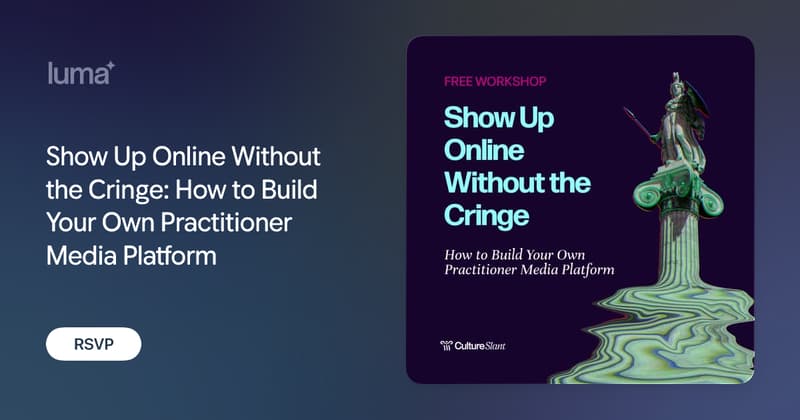
The R.E.I. Framework is just one way to share your expertise online. I’m going deeper on how else you can start building a platform around your knowledge in my FREE 90-minute workshop next week: Show Up Online Without the Cringe: How to Build a Practitioner Media Platform.
💻 ON MY RADAR
Alabama's "most popular sorority star" is actually an AI influencer
Chanty Beluga is this week’s viral internet moment, topped off with an interview with Rachel Karten
YouTube will now count a view as soon as a video starts playing
Reddit is experimenting with audio and video posts
This interview with Semafor founder Ben Smith on the anti-scale era of media
People put too much stock in things that go viral, according to this piece from Wired
Heinz’s latest product launch was inspired by a Reddit thread
AI will affect your social life (if it hasn’t already)

