
Everyone wants to build a creator business now.
And for good reason. The creator economy is booming; according to data from SharkPlatform, its estimated worth is $310.4 billion in 2026, with projections indicating it could exceed $500 billion by 2030. Around 207 million people worldwide identify as content creators, with roughly 50 million creators operating on a professional or semi-professional basis.
Many experts see this as a viable next step in their careers, where instead of getting paid solely for their expertise (like in a 9-5 or consulting), they're also getting paid for their POV (such as speaking on stages or writing a book).
So naturally, a creator business seems like the next best move. But a creator business runs on the same underlying logic: growth is the input, and monetization is whatever that growth eventually converts into. The person becomes the product. The algorithm becomes the gatekeeper. And what gets made is decided by what performs, not necessarily what's true or useful.
That logic works if reach is the thing you're actually trying to build. But most experts who look to build a creator business do so for the wrong reason.
Most experts don't actually want to build a creator business. What they really want is to build authority and influence around their expertise, so they become the go-to credible, trusted resource in their space.
That authority doesn't come from reach. It comes from judgment: what you choose to say, how you frame it, and whether it holds up over time. A creator business isn't built to protect that. It's built to chase attention, and attention and authority are not the same asset.
This is where practitioner media comes into play.
The case for practitioner media
Coined by Adam Ryan, Co-founder and CEO of Workweek, “practitioner media” is media rooted in your expertise and the work you're currently doing in your field.
Simply put, the content is inspired by the work you're doing day in and day out. Think people like Rachel Karten (Link in Bio) for social media, Lenny Rachitsky (Lenny's Newsletter) for product managers, and Tracey Wallace (Contentment) for content marketing.
Practitioner media gives experts a one-foot-in, one-foot-out approach, where you're both an expert and a creator. It's a media channel built alongside your work, not one that replaces it.
Unlike a creator business, the content earns trust rather than attention. Your audience isn't watching a persona; they're watching someone apply real judgment to real work in real time. Done right, practitioner media positions you as an authority within a niche professional audience because your expertise is proven in public, not just claimed.
You’re reporting from inside your own field, blended with the judgment to know what's worth saying and how to frame it. Practitioner media sits at the intersection of thought leadership and case study, part reporting on what you're seeing, part demonstrating what you're doing about it, and part interpreting how this impacts your audience and what it means for your industry's future. Authors cover trends in their industries alongside the frameworks, methodologies, and theories they're actively applying in their own work, work the audience can then apply to theirs.
Some of the things you might find in practitioner media include:
Trend analysis
Interviews
Case studies
Proprietary frameworks
Experiments
Practitioner media vs. creator business
A creator business runs on audience-first economics, where growth is the input and monetization is the downstream of reach.
In a creator business, the person is the product, and the content’s job is to keep attention following so that it converts into brand deals, products, and more. What matters in a creator business is what performs, not necessarily what resonates with audiences. The algorithm is the gatekeeper to success, so publishing volume and cadence matter. The success of a creator business is indicated by followers, engagement rate, and brand deals.
On the other hand, practitioner media runs on an expertise-first economics model. The expertise comes first, and the platform is built to carry it. Growth of a practitioner media platform is a byproduct of trust compounding, not the goal itself. Editorial logic dominates over distribution logic, meaning what gets made and how it's framed matters more than how often it posts. Success for practitioner media looks like citations, high-quality inbound leads, and being the reference point in a category.
Perhaps the biggest difference is that a creator business optimizes for reach, whereas practitioner media optimizes for judgment, and reach is just what judgment eventually earns.

Why practitioner media is better for experts than a creator business
Knowledge creators are a rising force, where expertise is the new currency of influence. Practitioner media keeps the content expertise-focused while still positioning you for bigger opportunities:
More aligned brand deals. A creator business chases broad reach because brands are paying for scale. Practitioner media attracts brands paying for relevance, ones whose audience actually overlaps with yours. Fewer deals, but a much higher fit, and a much easier yes for both sides."
You can go deep on your expertise. Instead of catering to the algorithm, you can use your media platform to go deep on your ideas to provide more value to your audience.
Content becomes one part of the job, not the entire job. Rather than content being your entire business model, your practitioner media channel is just one part of the job
You can grow your sphere of influence. Practitioner media allows you to reach not only the people in your immediate bubble, but across your broader industry.
Become a leader, not just an influencer. Be known for what you do and have your work cited and referenced by others.
Drive more inbound opportunities. Drive a variety of work, from consulting to speaking to press, just from your POV. Once people see how you think and apply the work, it speeds up the trust process.
How to build a practitioner media platform
You need three elements to build the premise of your practitioner media platform:
Professional target audience (the more niche, the better)
A channel for production (preferably something long-form like a podcast, YouTube channel, or newsletter)
A strong POV and approach around your work
Here’s what mine looks like (as I consider Culture Slant practitioner media):
Professional target audience: Experts who want to start sharing what they know online (specifically in-house SMEs, founders, consultants, practitioners, creator-journalists, etc.)
Channel: Newsletter
POV/Approach: Examining the intersection of media, culture, and technology to help professionals turn their expertise into a trusted, credible platform by deciding what to build, how to frame it, and how to make it compound over time.
Scratch the itch of content creation
You don't have to build a creator business to start getting paid for your POV. Practitioner media lets you scratch the itch of content creation while retaining your expertise.
But knowing the model is different from knowing how to build it. Most experts who try this alone spend months figuring out their POV, channel, and strategy through trial and error—time they don't have to waste.
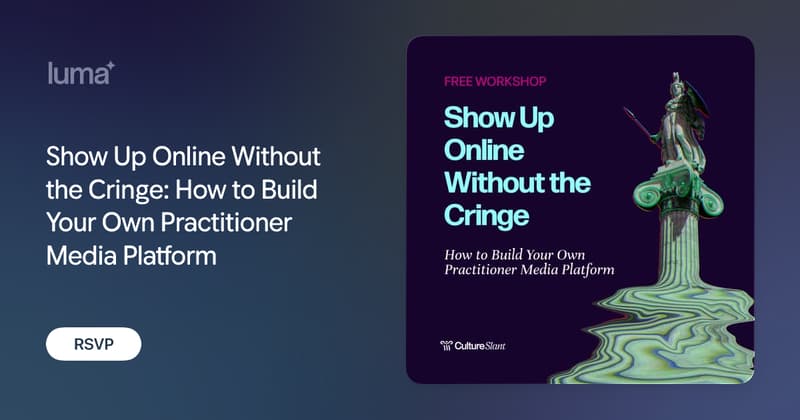
If you're an expert who's looking to start sharing what you know online and want the shortcut past that trial and error, sign up for my upcoming workshop, “Show Up Online Without the Cringe: How to Build Your Own Practitioner Media Platform.”
💻 ON MY RADAR
MySpace is teasing a comeback
Disney is renting out its IP to creators
YouTube is increasing its watch hour requirements for channel monetization
VC firms are going all in on creators
Mark Zuckerberg wrote a 6,500-word manifesto about AI
Clay instituted a company-wide AI writing policy
CreatorIQ released a new State of Creators report

